
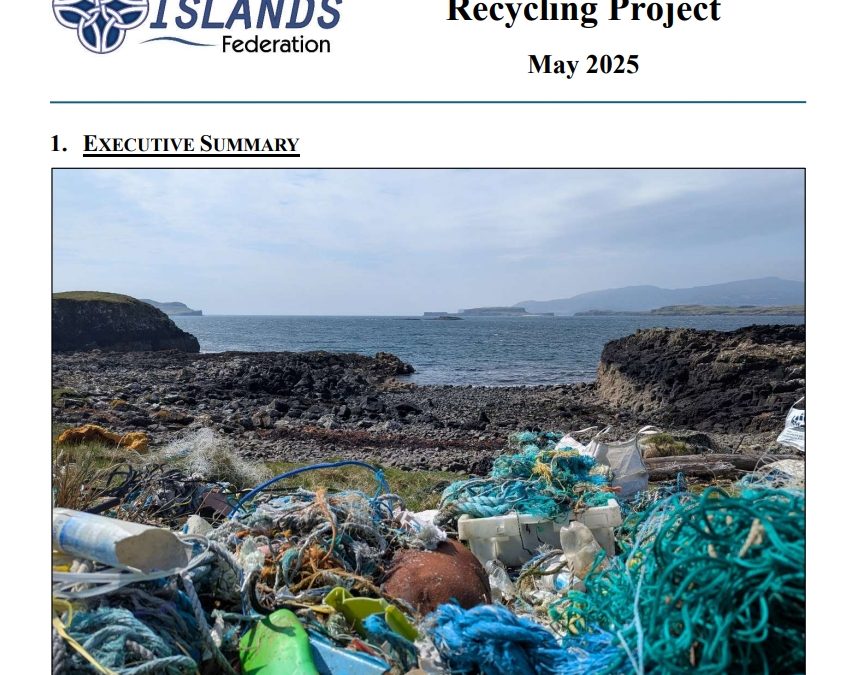
This report provides an overview of the activities undertaken in May 2025 as part of the Skye and Small Isles Recycling Project.
Launched in 2022, the initiative is led by the Scottish Islands Federation’s Marine Litter Working Group (SIF-MLWG) in collaboration with several local beach cleaning groups, Keep Britain Tidy’s Ocean Recovery Project (ORP) and Scottish Coastal Clean Up (SCCU). The pilot project aims to support island communities in transitioning towards a more circular economy by demonstrating alternatives to landfill for managing marine litter within island contexts.
Marine litter, primarily composed of plastics and other persistent materials, poses a serious and growing threat to marine ecosystems, coastal economies, and human health. The impacts on island communities are disproportionate, with challenges compounded by geographical isolation, limited waste infrastructure, and strong dependence on the marine environment. Addressing this persistent issue requires targeted and collaborative solutions at local, national, and international levels central to which is improving circularity in waste management systems.
Now in its third year, the project adopts a community-led, collaborative model that aligns with several key policy frameworks including the Circular Economy (Scotland) Act 2024, Scotland’s National Islands Plan, and Scotland’s Blue Economy Vision. It promotes reuse, recycling, and environmental stewardship through local engagement and practical action.
In May 2025, a coordinated programme of beach cleans was undertaken across several island and remote mainland locations, with a particular emphasis on the recovery of rigid plastics—drawing on lessons learned from earlier difficulties in handling heavy netting and rope potentially combined with lead. The initiative was coordinated by the SIF west coast Marine Litter Development Officer (MLDO), with local groups organising cleans often in partnership with Scottish Coastal Clean Up (SCCU). The Ocean Recovery Project facilitated the collection and transport of recyclable materials to central
recycling facilities.
Thanks to the dedicated efforts of volunteers and partner organisations, an estimated 7 tonnes of marine litter were removed from a selection of remote island and mainland shorelines. A significant proportion of this material was diverted from general waste pathways for repurposing or recycling by a selection of UK-based enterprises:
- Shore to Floor (Skye) a local artisan who received suitable rope to produce handcrafted mats.
- Ocean Plastic Pots (Glasgow) received recovered polypropylene fish boxes for recycling into durable plant pots and kitchen ware.
- Milspeed International Ltd. (Gloucestershire) received 235 kg of fishing net for recycling into footwear components and other products.
- MYGroup (Hull) received 520 kg of rigid and mixed plastics for recycling into products such as MYBoard.
The pilot has highlighted the logistical vulnerabilities inherent in remote clean-up operations, especially when reliant on favourable weather conditions, volunteer availability, and capacity for removing litter from poorly accessible beaches – notably boat operations. Additional barriers to alternative waste pathways include the complex composition of beach litter, contamination issues that hinder recyclability, and the high carbon and financial costs of transporting material from remote islands.
Nonetheless, the project continues to develop a scalable, island-based model for marine litter recovery and circular economy implementation. Through robust cross-sector partnerships involving community groups, NGOs, local authorities, and industry stakeholders, the initiative demonstrates that well coordinated, localised action can yield meaningful environmental and social benefits with promising potential for economic benefits and job creation.
Please follow link for full report – News – The Scottish Islands Federation